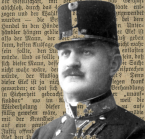

One of the more difficult aspects of writing about Alfred Redl is placing him in context. Despite liberal party propaganda to the contrary, Austria-Hungary’s Dienstadel was not the product of meritocracy in the public sector: opportunity came as a result of family connections. So how did Alfred Redl become head of the most sensitive military intelligence organ in rebellious Prague?
The only published work (I know of) which attempts to answer that question is Georg Markus’ Der Fall Redl. I have reservations about relying on Markus’s work because it’s often unclear from where he got his information. If you do look to Markus, however, you’ll see he places emphasis on the Redl clan’s roots in the nascent railway industry in Galicia. From my own research, this emphasis is well placed.
What historians seem to agree on was that Redl’s father worked on the imperial railway in Galicia. Istvan Deak sums up the popular opinion nicely:
By origin, Redl was a most typical Habsburg career officer and not, as the ficitionalized accounts would have it, an exceptional phenomenon. His father was a former officer who became a clerk at the Karl-Ludwig Railway company in Galicia.
The problem with this viewpoint is that it neglects context. The Galician railway was a highly politicized affair whereby Polish Nationalist industrialists sought to exploit Franz Joseph and his ‘in crowd’ of investors to lay the foundation for a future autonomous Polish state. The nationalist faction is best represented by Prince Sapieha, an aristocrat who, among other Polish aristocrats, avoided breaking their connection with the land and peasants over whom they ruled. Austrian aristocracy were not so far sighted.
Franz Joseph’s investor ‘in crowd’ were a motely crew of questionable London-based investors, like the Glyn family of Elinor Glyn fame and Jewish bankers like the Rothschilds and their satellite families.
The result of this ill-starred pairing was the Karl-Ludwig Railway, which was never clearly profitable and didn’t benefit the vast majority of people in the lands through which it ran. The Hapsburg perspective was that this railway would get Polish and Czech raw materials to Viennese industrial concerns.
The problem was that planned economies are rarely efficient economies. Highly-regulated industry paired with plutocratic policies stifled broadly-based industrial growth throughout Franz Joseph’s reign. The common people never saw any of the benefit accrued to bankers like the Rothschilds. This inequitable situation was so extreme that it lead less diplomatic observers like Foreign Minister Lexa von Aehrenthal to quip that only Jews could afford to ride the network of lines lacing the Hapsburg’s Russian border. Local press bemoaned Sapieha’s railway as “built by foreigners to benefit foreigners”.

To add insult to injury, when Sapieha built his ‘nationalist’ line, it was in support of Polish nationalism, not necessarily the nationalisms of the diverse peoples through whose land his railway ran. Local Czechs couldn’t get a job on these rail lines, rather foreigners who didn’t speak the local languages were imported, like Redl’s family.
Sometimes the exact origin of these imported railway workers was hard to determine— Redl’s family was believed to be German, Polish, “Polonized German” and Jewish depending on who you asked. This was a common problem the world over as the major international banks who financed railways liked to use a workforce that was both alienated from the local populace and disconnected from alternate job opportunities. In fact, it was common practice for imperial economies to off-load criminals as labor in undeveloped areas, and import “coolie” labor from India or China to build tracks in more progressive places. It was common in Central Europe for railway tycoons to favor their own ethnic group when staffing railway lines— this was one avenue for marginalized Jews to enter mainstream German-speaking society.
Which brings us to a different problem: the questionable profitability of the railway… with respect to licit goods. Austria-Hungary’s border with Russia was ground zero for highly-organized Jewish smuggling and trafficking networks. The “White Slave Trade” traffickers counted Galicia as their homeland. Unreliable transport schedules, questionable profitability, and crooked railway employees made the Karl-Ludwig line a haven for organized crime and information peddling. The epicenter of this activity would be the center spoke of the network, the station at Lemberg where Redl’s father was said to have worked.

Which brings us back to Redl’s father. What exactly he did for the Karl-Ludwig line is obscure. By searching through employee directories of the period, I can say that there was only one man surnamed ‘Redl’ working for the railway during the relevant period. This man, “Franz Redl” began his career as a porter for the line and ended it as a type of receiver/accountant for cargo shipping payments. That final position in Lemberg would have put ‘Franz Redl’ in an intelligence hot-seat.
Markus claims that Redl’s first intelligence assignments were mapping and cataloging the strategic characteristics of railway networks along Russia’s border. This would make sense given that the General Staff was very interested in the military potential of railways over the span of Redl’s career and that being the son of a railway employee, Redl would have some innate knowledge of these transportation systems.
Of course, if Redl’s father was part of Jewish organized crime networks which benefited from the railway’s corruption, then Alfred would be doubly well placed to siphon off important information and contacts form both Austria-Hungary’s and Russia’s criminal underworld. The Hapsburgs were particularly keen to partner with this underworld in politically unreliable places like Galicia, Hungary, Italy and Bohemia (Czechoslovakia). It would take an exceptionally valuable man to make the transition from porter’s son to colonel in three decades.
My sources and more information on this topic will be available in my book, which is now in the final stages of editing and will, hopefully, be on sale at the end of July. If you’d like to order an advanced copy, please send me an email at elizabethadams@gmx.us.
To finish up, I’d like to direct readers to what remains of the Karl-Ludwig network today: it suffers from the same problems now that it did 140 years ago…
“Neither for Us, Nor for Our Neighbors: A Visual Story from Zaborona About the First Hungarian-Galician Railway— Which Doesn’t Benefit Anybody.” by Pavlo Bishko.
 Col. Alfred Redl