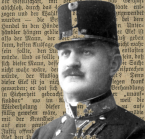

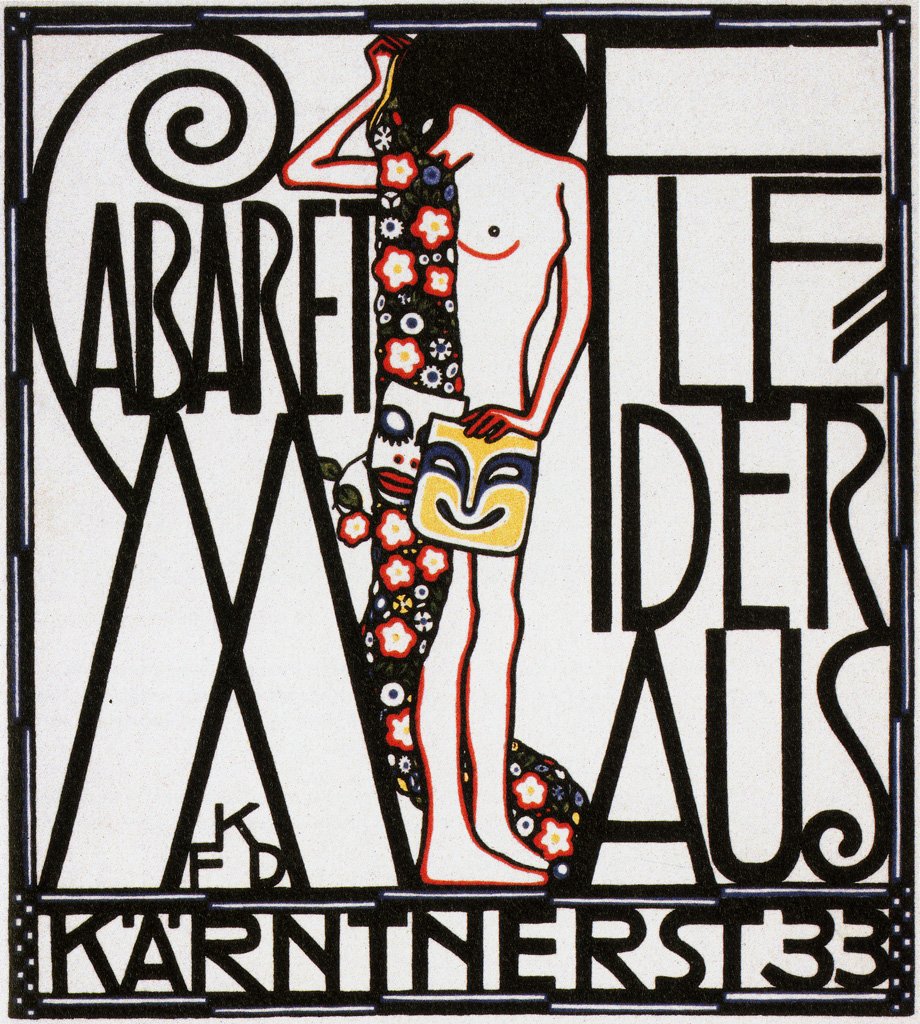
I wrote previously about Lucy Koenig and her connection to Alfred Redl: Vienna’s best informed and respected theater broadsheet, Weiner Allgemeine Zeitung, reported that Redl had a paid-sex relationship with a female diva of the Cabaret Fledermaus. (Redl wasn’t purely gay, readers, if he was even gay at all.) Lucy Koenig was the current prime offering at that private nightclub when Redl’s treachery was discovered. If you’d like to understand why WAZ’s testimony is so valuable, try my book.
In fact, the Cabaret Fledermaus has a strange chronological synergy with the career of Alfred Redl: it opened the same year Redl began to make the big bucks from his treachery, and the theater closed down a few weeks after his ‘suicide’. The financiers of the Fledermaus were the same financiers of Die Zeit, the newspaper which actually broke the Redl Scandal, not Kisch at Bohemia.
Want to understand why these odd synergies exist?
The Kriegsarchiv in Vienna is widely considered the gold-standard archival resource for information on Redl’s career. It’s is exceedingly unlikely, however, that anything pertaining to the Cabaret Fledermaus, or prostitution more generally, made it into Redl’s Wiener Kriegsarchiv files despite the fact that his responsibilities covered Prague, where police and pimping were heavily intertwined even by Hapsburg standards. (The top bordello there was run by an ex-cop.) Why does this information hole exist? The Kriegsarchiv was designed as a tool to protect the reputation of the military and the emperor. Slavery and prostitution don’t look like good statecraft.
None the less, truth does exist outside of classified files. The organized-prostitution connection with fin de siècle intelligence services (not just the Hapsburg, either!) is something that doesn’t get much play in intelligence histories or, I’ll risk guessing, even in the classified materials on Redl held by WWI’s surviving governments. Personally, I’d have known nothing of this connection if I hadn’t read Edward Bristow’s book on the Galician White Slaving Network, or The Women Police of Poland by Stanisława Paleolog.
What did this connection look like in practice? The pimps who ran the the slaving networks— child-grooming networks by enlarge— supplied intelligence to military officials on both sides of the Hapsburg/Romanov borders. These same thugs were also useful as paramilitary forces quashing workers’ strikes or nationalist uprisings. They were a sort of Central European answer to the contemporary American phenomenon of “The Pinkerton Detective Agency”. (Who knows, they may have had a similar employee demographic.)
On one hand, this shouldn’t surprise anybody. Spooks have used criminals as informants from time immemorial: we all know that American forces used Italian mafioso (also pimps!!) to ‘stabilize’ Italy after 1945. Maximilian Ronge talked about criminals a lot in his espionage book and the utility of organized international Gypsy smuggling networks for spy-work was openly celebrated by Austria-Hungary’s premiere criminologist Hans Gross. However, in the case of the Galician network there seems to be a conspiracy of silence, a sort of desperate attempt to sweep the sins of the fathers under an intellectual rug.
What might motivate this desperate silence? The fact of the matter is that Austria-Hungary’s bureaucratic and military elite in the run-up to 1914 were more heavily drawn from Romanov-border organized crime families than ever before (e.g. rich minority immigrants from economically depressed places such as Galicia). To expose Redl’s, or any other Hapsburg intelligence official’s, connection with organized crime was a little too much like airing the Dienstadel’s dirty laundry. Many of these “adel” came from trade families at a time when state-sponsored monopolies and plutocratic favoritism were the Hapsburg’s favorite tools for government, i.e. Dienstadel history looks very bad for the emperor, too.
If this were just a Hapsburg problem, the conspiracy of silence would have ended in 1918. It did not end. Many of this parvenu and privileged new “Dienstadel” immigrated to London and New York on a wave of Anglophilia that swept Vienna’s Jewish community beginning a few years prior to Cabaret Fledermaus’ founding. It’s probably no coincidence that this diasporic flight happened over a time when aggressive domestic political factions in the Anglophone world were setting up their own “intelligence agencies” parallel to preexisting military ones (1907+).


Given the profound impact this Anglophile “avant gard” immigration had on organizations that would become MI-6 and CIA, NSA etc., a closer look at Hapsburg attitudes towards intelligence and the sex trade is in order.
First of all, the end-destination for trafficked women and children inside Austria Hungary was entirely controlled by local police forces because policy from the top— Hapsburg policy— was that prostitution should be “illegal but tolerated at the will of the police”. Government-licensed whorehouses bought these trafficked people; small-time local pimps were not the consumers of Galician network “product”. Organized prostitution was a state-sponsored industry in Austria-Hungary where local police were tasked with enforcing the monopolies of favored pimps and traffickers. Let that sink in a moment. Madames operated ‘under the protection’ of the police.
- When trafficked women ran away from their bordellos, the police were tasked with bringing them back.
- When foreign traffickers wanted to buy women/children in Budapest, for example, they paid the local police a harvesting fee.
- When women had the (vanishingly rare) good luck to buy their freedom from their madams, the local police watched the ex-prostitutes more closely than known criminals (according to Julius Kemeny). These living victims were a threat to the network.
Also bear in mind that in Austria-Hungary there was not the distinction between policing and military functions that we are accustomed to (imagining?) in the Anglophone world. This situation is largely due to the way police forces in Vienna and politically unstable border territories evolved. New “policing measures” developed in response to military and political crises. In Hungary, it was the police who were responsible for military “mopping-up”-type actions. In Vienna, and every major city, it was the police who were responsible for censoring theaters and publishers— except in the situations where foreigners were involved, in which case these “policing duties” fell under the jurisdiction of the Foreign Office. Theaters, opera houses, movie theaters all operated at the will of the police, just like bordellos. (Note too that the Viennese police identified musical theater troupes as a primary cover for international sex-trade human trafficking— they should know.)
Consequently, the intellectual side of police work— criminology— was basically an offshoot of the military, with leading criminologists being drawn from military scouting and medical backgrounds.
The medical-sex industry nexus is also a result of Hapsburg policy. It should never be assumed that just because the Hapsburgs adopted very liberal sex industry policies that these policies were popular ones. The vast majority of the population hated prostitution and the political corruption that blossomed wherever it was tolerated.
In response to growing criticism, the Hapsburgs adopted a new strategy: the medicalization of prostitution. Now, “skin doctors”— largely upper-class Jewish immigrants to cities from borderlands with Russia— would decide which madams could operate via their dubious “health certifications” for prostitutes. Jewish doctors often found exceptional opportunity in the military’s health apparatus, as both it and its training institute the Josephinum in Vienna were among the first medical institutions opened to Jews by imperial decree. Now we have the confluence of military-connected doctors controlling the military-encouraged bordellos, staffed by Jewish organized crime, whose monopolies and ‘capital’ were “protected” by the local police, who themselves operated as extensions of the military.

The Hapsburgs weren’t stupid. They evolved the system of tolerated prostitution as a political stop-gap: whoring both distracted a demographic prone to political organization and rioting, as well as corrupted nascent democratic institutions which would otherwise have been nationalist-controlled. There’s no one an imperialist hates more than a nationalist.
How did Franz Joseph control the criminial-military-policing-pimping nexus he needed to undermine nationalist uprisings?
He needed a man on the inside of the family networks which controlled the product central to his new managed economy: the supply of European sex slaves. When Redl was eventually outed, the fig-leaf adopted by Ronge and his sponsors was to work more closely with the state-interface to this slave trade, the police.
There is no better source on Redl’s final days than the newspapers controlled by the plutocratic families who also profited from this slaving network. Read all about it!

